


The Groupon Paradox – How it can destroy your business!
- What is Groupon’s paradox?
Groupon’s business is designed to increase consumer purchasing power by bringing companies groups of customers (from deep discounts offered) in order to boost sales. They offer a contradictory sales pattern, a boost in sales transactions, but a decline in sales profitability.
Below is an example of how price erosion occurs:
“The logic is simple: Merchants are encouraged to use the deals to attract new customers, who in theory will return at full price. But, in what seems to be an increasing number of cases, customers come for the deals and then leave for deals offered by other merchants through Groupon. So the number of “new” customers attracted by cheap prices increases, and the number of loyal customers decreases as shoppers prefer to become “new” again for whomever offers the best deal.” - What are the ramifications of Groupon’s success as far as consumers buying habits are concerned?
There was a time when we would visit stores to ‘browse’ or see whether or not they had a sale. By doing this, we saw regular priced items and encountered the good old fashioned sales pitch. Retailers counted on this, sales drawing customers in, but regular price purchases keeping them profitable. But now, as consumers, we might not even bother leaving our house without a coupon in the first place. Groupon is making it even easier for consumers to hunt deals and save 50% and more off meals, travel, services, and day to day commodities. By doing this, we’re growing to expect and even demand a deal with every purchase, which is sinking retail profitability significantly. - How is Groupon affecting retail business behavior?
Retail businesses often struggle because of consumers always looking for a deal. This comes out even more during hard economic times (which we currently face). The problem that Groupon causes is that consumers now come to expect some form of coupon or sale when shopping. In fact, many times, the consumer won’t even bother going shopping without a coupon in hand.
Groupon’s success is only going to encourage other companies to generate daily deal sites (i.e. Livingsocial, Surrey.com, Red Flag Deals, etc.) and businesses will continue to offer more and more and deeper and deeper discounts. Eventually, all of the smaller businesses will shut down, they don’t have pockets deep enough to ‘out discount’ the big players in the market. With the ‘discount era’ growing rapidly around us, you’re going to see more retail businesses closing their doors, unable to compete in a market driven by price. Unfortunately, as the recession continues, so will the bargain hunting. Businesses need to start pushing things like their value proposition in order to overcome the competition’s pricing war. - How might a marketing intermediary such as Groupon fit into an Integrated Marketing Communication strategy?
Groupon’s best use is for a company that utilizes high margins in the first place. These companies may cut their margins, but still remain profitable. Depending on the ROI they require, companies may only need to secure 2-3 loyal customers from the total costs of running a Groupon ad in order to break-even. This type of marketing is great for generating awareness and initial sales. Some companies may have trouble getting exposure, but by being emailed to 50+ million user inboxes, they’re likely to see some increase in sales.
Where Groupon does not work? For companies that have great market presence and don’t need to that additional exposure. Why would a profitable company that already has a strong client base send out mass discounts? The chances are that they are simply discounting products/services that existing customers already would buy at full price. They are likely not going to generate enough NEW customers to cover the forfeited revenues from existing.
Once a company has appeared on Groupon, people will expect a discount and may stop buying from them until another surfaces.
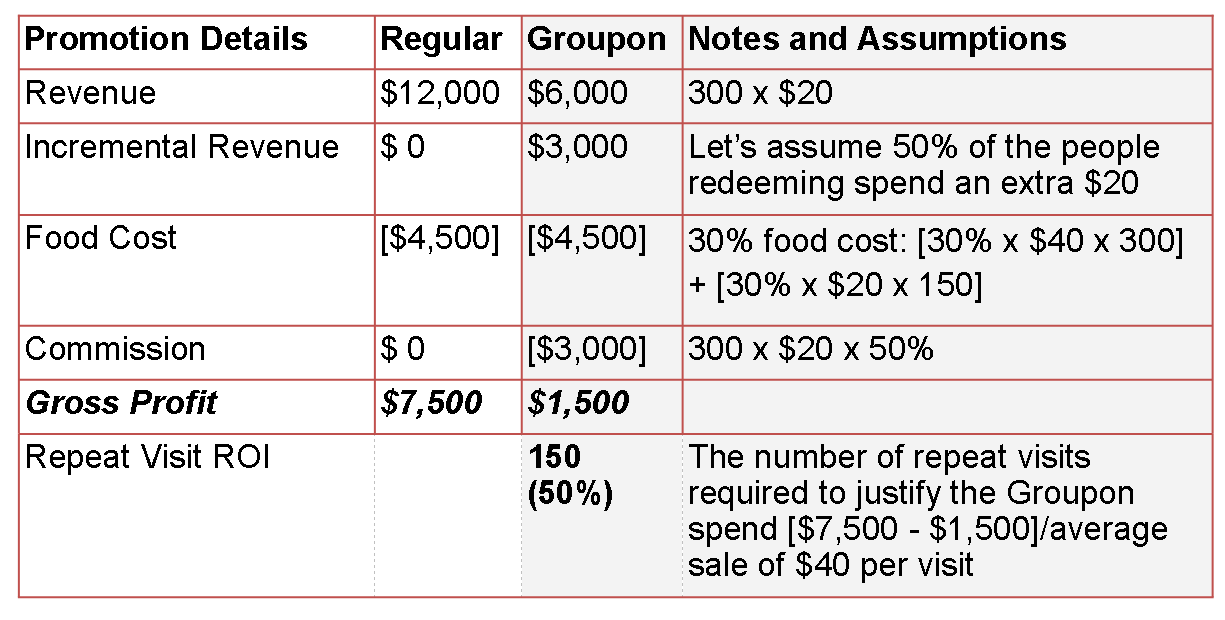
Here is a chart that breaks down an example of ROI required from a Groupon deal
Summary
In my opinion, there are so many better ways to advertise and connect with your market. Groupon seemed like a good idea, but now it’s only generating consumer expectations and sinking retail profitability. Take a look at this link, a book written solely on why Groupon discounts are bad for business.
http://www.retaildoc.com/blog/groupon-worst-marketing-business/
 Mark Wilson
And..how it’s destroying itself…http://www.businessinsider.com/chart-of-the-day-groupon-stock-2012-4?nr_email_referer=1&utm_source=Triggermail&utm_medium=email&utm_term=SAI%20Chart%20Of%20The%20Day&utm_campaign=SAI_COTD_042012
Very interesting, though not surprising, I’ve been reading about them having issues for months now. Thanks for sharing the link!